
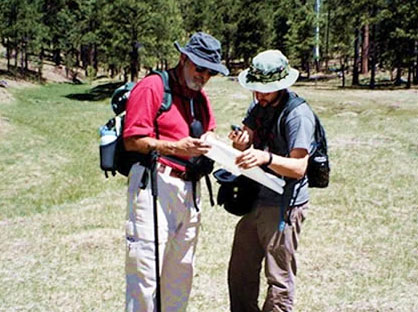
Because Mexican gray wolves are so rare and endangered, wildlife biologists study them intensely to find information that can help ensure their survival. To aid in their efforts, wolves in each pack are fitted with radio tracking devices. Biologists use hand-held antennas to pick up signals from the tracking devices and follow the beeps to the wolves where they can observe behavior, study kill sites and monitor animal health.
This page of our site is where we’ll be providing updates from these biologists, including the general locations of packs, how their pups are doing, if new wolves have joined the packs and more. So, check back frequently and get to know your wild Mexican gray wolves.
Here are some highlights from our 2012 visits to Mexican gray wolf home ranges.
Welcoming spring in Middle Fork territory
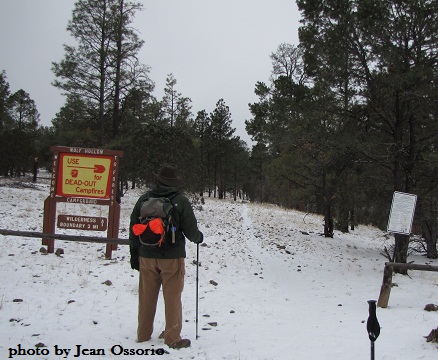
Follow the Pack headed out to the wintery Gila National Forest in mid-March 2012 to look for tracks of one of our favorite packs, the Middle Fork Pack. One snowy morning we put on our boots and packs and hiked up Wolf Hollow, near the eastern edge of the pack’s home range. A white sign to the right of the trail reminded us that we were in wolf territory.
The Wolf Hollow trail follows the creek through a forest that consists mostly of ponderosa pine trees. When the trees are young, their bark is dark gray. As the trees grow, the bark on their trunks develops deep cracks. The bark in the cracks is red-orange.
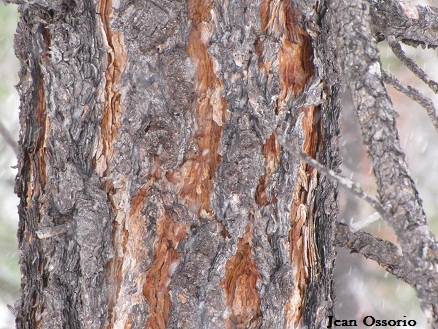
Eventually, when the tree is much older, the gray disappears and the bark is almost completely red-orange and smooth.

Soon we found signs of one of the creatures that share the habitat of the Middle Fork pack. Can you guess what animal made these holes in the ponderosa pine tree?

If you guessed that a woodpecker made these holes, you’re right. An acorn woodpecker drilled these holes to store its favorite food, acorns! If you look carefully, you can see acorns in some of the holes in the picture. You can see acorn woodpeckers in action at this link.
On the first day of spring, we visited Cooney Prairie, another place the Middle Fork pack calls home. We didn’t see any sign of the wolves, but we did find sign left by one of their favorite prey animals. Do you know who left these droppings?
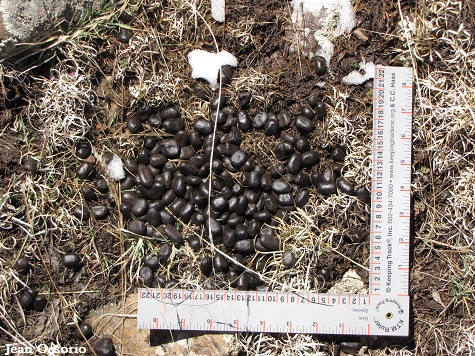
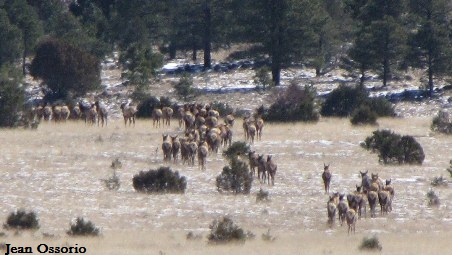
It was an elk, probably one from this herd.

These elk were part of a large herd. We watched the herd as it crossed the prairie and finally disappeared into the trees on the other side.

Another visit to the Hawk’s Nest home range
In June we paid another visit to the home range of the Hawk’s Nest pack. The alpha female of Hawk’s Nest, AF1110, had been killed by a lightning strike in August 2011. (For more on AF1110, click here.) Her daughter, AF1208, had become the new alpha female. We were hoping to find tracks of the Hawk’s Nest wolves, or perhaps hear them howl. We were also interested in seeing how the Wallow Fire, which swept through the pack’s home range in May and June 2011, had affected the wolves’ habitat.
We soon learned that the fire had not made a clean sweep through Hawk’s Nest territory. It had burned some areas heavily, but had barely touched other parts of the pack’s range. Some trees were completely scorched. Others were still green.
Nearly everywhere, green plants were coming up under the burned trees.
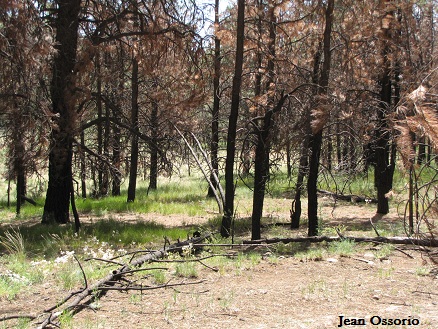
The open meadows had suffered very little damage. Animals like these elk were eating the lush, green grasses and drinking from pools of fresh water.


After watching the elk for a few minutes, we sat down to rest and eat lunch in the shade of a tree at the far edge of the meadow. Soon we noticed a dog-like animal coming across the grassy meadow. We could clearly see the dark radio collar around the creature’s neck. It was Hawk’s Nest AF1208, the new alpha female. Her fur looked wet. She must have been wading in the water in one of the pools in the creek bed.
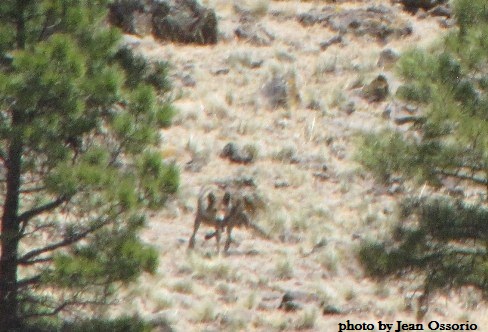
As soon as AF1208 disappeared into the trees, we noticed another wolf much farther away across the valley–so far away that it was impossible to see well, even with binoculars. Only after we got home and looked carefully at one of our photos on the computer were we able to see the back leg that AM1038 carries at a strange angle, due to an old injury he suffered while alpha male of the Fox Mountain Pack in 2008. Can you see that he isn’t putting any weight on his right rear leg?
In August, Follow the Pack returned to the wolf recovery area to help lead a workshop on tracking animals. Here the instructor demonstrates how to trace a track on a sheet of acrylic material. Tracing tracks requires careful observation, which helps in identifying them.

Three visits to Fox Mountain territory
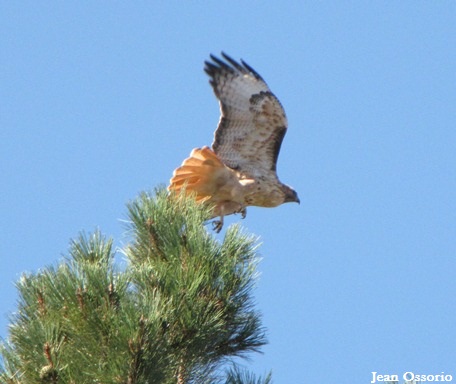
The home range of the Fox Mountain Pack in New Mexico was our destination in September. We didn’t see the wolves, but we did see several of the creatures that share their habitat. This red-tailed hawk posed for several photos before taking off from the top of the tree where it sat.
A snake swimming in a stock tank…

…and a tarantula at our campsite were among the wild creatures we observed.

When we returned to Fox Mountain territory in early November, the weather had changed. Nights were cold. The wildflowers we saw in September had disappeared, leaving behind their seeds. Fresh snow greeted us one morning.

Although we always welcome a snowfall, because it makes tracking easier, the real highlight of our trip was seeing the tracks of one of the Fox Mountain pups in the muddy bank of a stock pond near our camp.

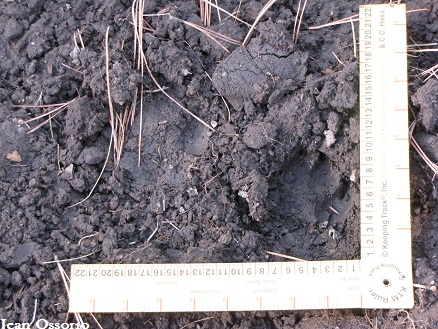
In the second photo, the larger track on the left is a front track, and the smaller one on the right is a rear track. Just like your domestic dog, wolves have front paws that are larger than their rear paws. (If you have a dog, take a look at its paws and see for yourself!) Larger front paws help support the greater weight of the head and chest at the front of the dog or wolf.
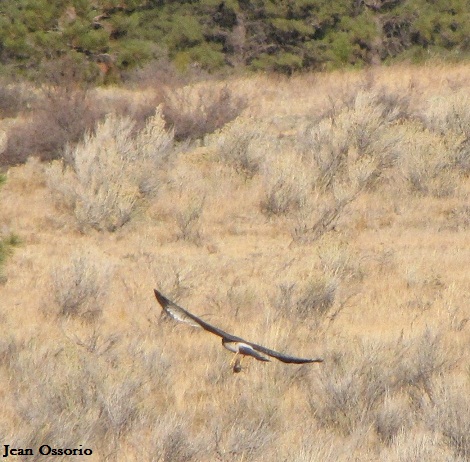
When we returned to Fox Mountain territory in late November, we found no wolves, but lots of other wildlife. While drinking our morning coffee, we watched this northern harrier swoop down, snatch a small animal from the grass, and carry it off for breakfast.
A short while later, a large herd of elk came running down the hill toward our camp. We heard them before we saw them. Their hooves pounded, sounding like thunder as they ran. When they saw us, they turned, ran up the hill, and disappeared, only to reappear in a few minutes on a ridge across the forest road. They started to move down toward the road, then stopped, looked around, and again ran up and over the ridge.
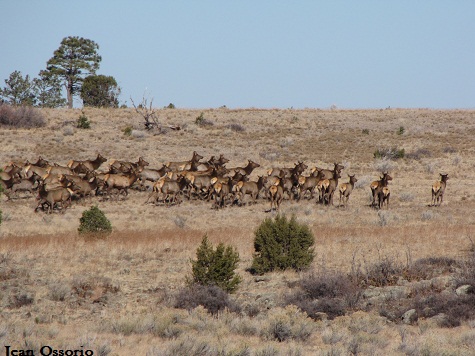

Although we didn’t see or hear the wolves, the elk made our short visit memorable.

Winter in the recovery area
Follow the Pack has been taking mid-winter camping trips in Mexican gray wolf home ranges since 2001. This year, we left for the Luna Pack’s home range the day after Christmas. Because we got a late start, we spent the first night of our trip at the Datil Well Campground, which is near the wolf recovery area, but not actually in it. This sign at the Bureau of Land Management campground gives a little history of the area.
According to the sign, the peak year for “trailing” cattle and sheep along the “hoof highway” from Springerville, AZ, to the railroad at Magdalena, NM, was 1919. This was also the heart of the period during which federal agents were shooting, trapping, and poisoning hundreds of wolves and other predators in the Southwest on behalf of the livestock industry. (For more about lobo history, check this link.)
Mexican wolves travel widely within their home ranges during winter. Pups are beginning to move around separately from the rest of their packs. It can be difficult to predict from one week to the next where a pack will be. The same snow that makes seeing tracks easy may also make roads impassable. After studying the map and checking on weather predictions, we decided to look for tracks and listen for howls of the Luna Pack in New Mexico.
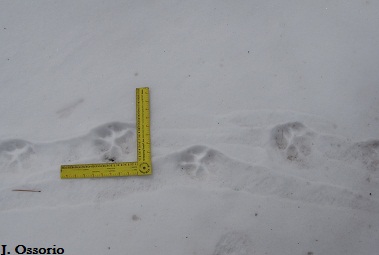
On our way to look for a place to camp, we found several sets of large tracks that were almost certainly wolf tracks crossing the road and heading off into the forest.

We found a campsite with a view of a large open area. If wolves or a herd of elk came along, we would be very likely to see them. As we set up our tent and fixed dinner, snow clouds gathered.

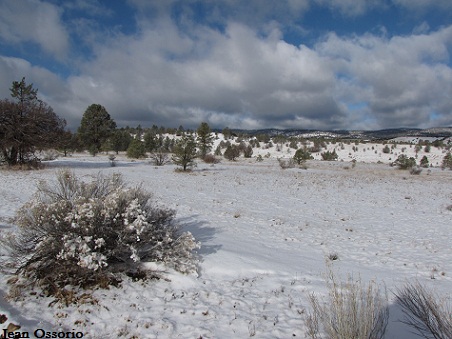
The next morning the sun rose on a winter wonderland, but before it did, in the pre-dawn darkness, we enjoyed a distant serenade. A pack of coyotes howled from the northwest, their song full of yips and barks. Even farther away to the north, we heard smooth, melodic howls that we’re certain came from the throats of their larger cousins, the wolves of the Luna Pack.
When we hear wolf howls and find wolf tracks, we are reassured that at least some of the reintroduced lobos are thriving, hunting elk, raising pups, and patrolling their home ranges, in spite of all obstacles. We rarely see them—only once out of 24 days camping in their home ranges in 2012—but just knowing they are there is enough. As long as the lobos survive in the Southwest, Follow the Pack will be out looking for them and reporting what we find.
Follow the Pack, March 1, 2012
Luna Lobos on the Continental Divide
The Continental Divide (See note at the end of this story.) meanders like a serpent across the Gila National Forest in southwestern New Mexico, followed closely by the Continental Divide National Scenic Trail. Hikers on the trail may be unaware of the fact that they pass through the home ranges of at least two families of Mexican gray wolves: the Luna Pack and the San Mateo Pack. Follow the Pack decided to spend part of our annual winter trip in the home range of the Luna family of lobos, near where the Continental Divide Trail crosses a major forest road.
The January sun was sinking low in the west as we entered Luna territory after a long drive across the grassy Plains of San Agustín, home to grassland wildlife like these pronghorn.

Recent snowfall had left the graded road muddy, slippery, and full of ruts. As we drove up a narrow canyon we encountered more and more icy patches. We hoped to find a place where we could pull off the main road and camp, but deep snow blocked the entrances to side roads. We continued driving in the gathering darkness until we broke out of the forest into an open area where the sun had melted much of the snow. We pulled off and pitched our tent right out in the open, near a lone tree. Racing against the dark, we unrolled our sleeping bags, ate some sandwiches, drank some hot chocolate, and got ready for the long, cold night ahead.
Several times during the night we awoke to hear coyotes howling and barking in the distance. We also heard something even more exciting. Wolf howls pierced the stillness from the southwest. One voice was especially deep and resonant. We wondered whether it was Luna AF(alpha female)1115 or possibly her new companion, Morgart’s Pack M1155. The Luna alpha female’s mate and the father of her pups had disappeared in April, leaving her to raise the pups with the help of at least one yearling wolf. M1155 lost his original mate when she died accidentally in October. Since the beginning of January he and Luna AF1115 had been traveling together. We were hoping the pair would stay together for the 2012 breeding season.
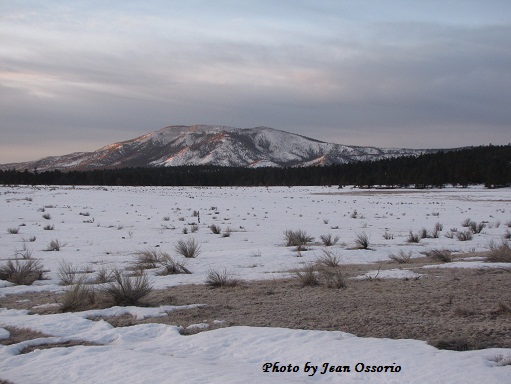
When we crawled out of our tent in the early morning, it was very cold. We pulled our hats down over our ears and made sure our parkas were zipped up as we watched the sun paint the higher slopes of Elk Mountain with patches of pink and gold.
After breakfast, we walked along the road, searching the mounds of soil pushed aside by the road grader for rocks large enough to use to build a fire ring, so we could safely enjoy a campfire in the evening. There, in deep mud that was now partly dry, we found several wolf tracks. We were thrilled to know that at least one of the wolves had walked right up the road only a few days earlier.
Later in the morning, we hiked down the road toward the Continental Divide. The road was very muddy from melting snow. So much mud stuck to the soles of our boots that our feet seemed to weigh several pounds each! We decided it was easier to walk in the snow along the side of the road than on the road itself. When we reached the spot where the Continental Divide Trail crosses the road, we found it was marked with a little blue symbol on a post. This part of the trail looked like easy walking. The part that climbs to the top of Elk Mountain would be much harder!

We found a dry place to sit quietly and watch for wildlife while we ate lunch, but saw only a few small birds, mostly juncos and chickadees, in nearby trees.

As the sun sank behind the Continental Divide, we sat by our campfire and wondered whether we would hear the lobos again during the night, howling from the hillside at the left side of this picture.

The night was quiet at first, but just before two o’clock in the morning we heard wolves howling and barking. We heard them again at 3:40 a.m. and yet again at 6:30, this time from a little farther away. No matter how many times we wake to hear a chorus of wolves howling in the dark, we always sit bolt upright to hear with both ears, so we can better tell the direction of the wolves. This time, like the night before, the song came from the hillside along the Continental Divide.
Middle Fork wolves in the wilderness
The next morning, after a very cold night, with a low temperature of +8?F, we packed up our gear and drove to the home range of our old friends, the Middle Fork lobo family. Recent flight reports showed the pack several miles to the south in the Gila Wilderness, but we hoped that they might have moved farther north since the flight, or that we might at least hear them howl. We set up camp at the same spot just west of Cooney Prairie, where we had camped in early December. (See Follow the Pack for December 31, 2011.) The weather was warm enough that we could enjoy sitting around the campfire in fleece shirts and sweaters, at least until the sun set.

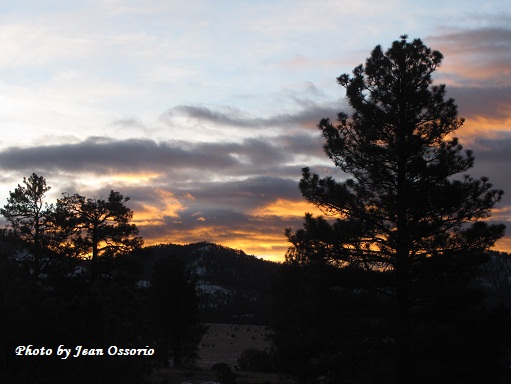
After a very quiet night, we awoke to a colorful sunrise. We knew that a red and gold sky in the morning often means bad weather ahead, so we set off on a hike soon after breakfast.
A short distance down the road we came to a huge juniper tree. A juniper this large could easily be well over 500 years old. We imagined how many generations of Mexican wolves must have rested in its shadow, before the lobo was completely killed off in New Mexico. Now reintroduced wolves from the Middle Fork pack pass by the old tree as they patrol their home range.

This type of juniper tree gets its name from the fact that its bark resembles the skin of a very large reptile. What kind of juniper do you think it is? (Answer at the end of the story.)
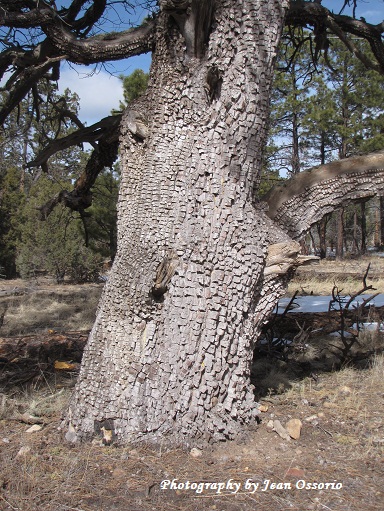
Apparently the Middle Fork wolves were still in the Gila Wilderness. Although we found elk and coyote tracks on our hike, we saw no wolf tracks or scat. By the time we returned to our campsite, dark clouds had begun to gather. We listened to the drumming of woodpeckers and the croaks of ravens, and watched an Abert’s squirrel, with its long, tufted ears, scurry among the trees, as we ate an early dinner.
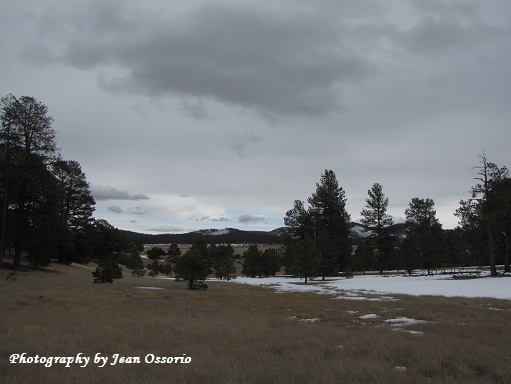
The next morning we were in for a surprise. New snow was falling, giving every tree and bush a frosting of white.

Cooney Point was almost invisible in the fog and snow.
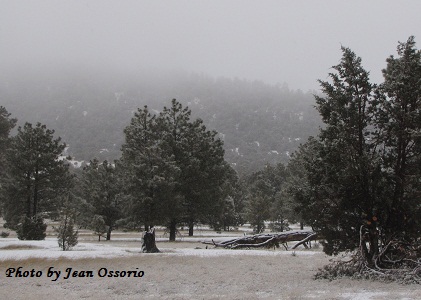
Cooney Prairie took on a strange, mysterious appearance.

The best surprise of the trip was still to come. As we drove very slowly along the slippery, muddy road to the highway, a small herd of cow elk loomed up out of the fog.

We watched as they trotted off through the fog. It was a perfect ending for our winter trip in Mexican gray wolf country.

Notes:
1) The Continental Divide is a natural boundary line that separates the rivers and streams that flow into the Gulf of Mexico and the Atlantic Ocean from those that flow into the Pacific Ocean. You can see a map of the Continental Divide and read more about it at this link.
2) The big juniper tree is an alligator juniper, named for the fact that its bark looks like the skin of an alligator. Many birds and animals eat the berries of the alligator juniper. Native American tribes have also used the berries. The wood of this tree is sometimes used for fence posts or for fuel.
3) The Mexican gray wolf reintroduction project annual population survey for 2011 was conducted in January and released on February 3, 2012. The survey showed that the Luna and Middle Fork families of lobos each had at least two surviving pups at the end of 2011.
Follow the Pack, December 31, 2011: San Mateo Tracks

Follow the Pack returned to the home range of the San Mateo pack of Mexican gray wolves just after the autumnal equinox. We camped in the same little valley where we had camped in August, but we weren’t sure we would find any sign of the San Mateo lobo family this time. By early fall, wolf pups are getting bigger and packs are starting to move around, so we weren’t sure the pack would still be nearby. Rainy weather had left the ground soft and muddy, however. If the wolves were in the area, we hoped to find their tracks.
The next morning we hiked up the forest road that leads up the valley to the southwest. Not far from our camp we found our first tracks in the muddy road. Can you identify the animal that made this track? It’s a large animal that is omnivorous. That means it eats both animal and plant foods. (Answer at the end of this story.)

A little farther along we found this track. Can you tell what animal made it? It is an ungulate, an animal with hooves. It’s the favorite food of Mexican gray wolves. (Answer at the end of the story.)

As we continued hiking up the valley, we found more and more evidence of recent heavy rains. The road was so washed out that it began to look more like a creek bed than a road!

In a little while we came to a place where a small stream crosses the road. In the muddy creek bed we found dozens of Mexican gray wolf tracks, both adult and puppy size.

We all made casts of lobo tracks.

After the casting material hardened, Pamela and Cynthia washed the mud off their track casts.

Everyone went home with a wolf track cast as a souvenir of our trip.
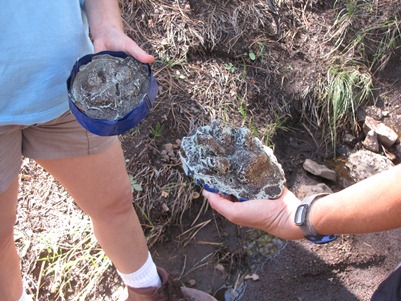
In early October we returned to the little valley and pitched our tents. This time we got a surprise when we woke up the next morning.
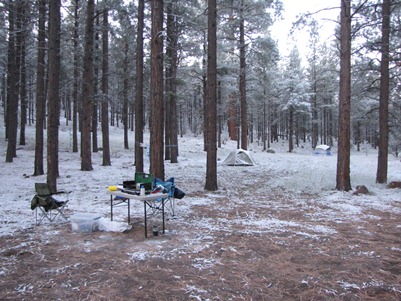
A light snow overnight had turned the San Mateo pack home range into a fairyland.
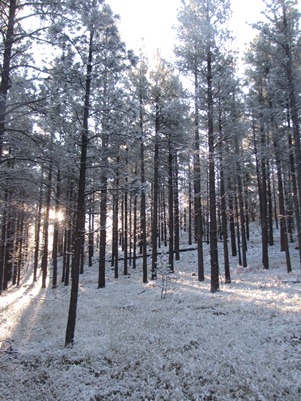
Soon the warm sun melted most of the snow. We hiked back to the place where we found the stream bed full of lobo tracks ten days earlier. Rain had raised the water level in the stream. The tracks were now under water!

Although many of the tracks were below the surface of the water, we were able to make casts of a few tracks higher on the muddy banks. Lora is pouring the wet mixture into a circular “dam” made of strips cut from a plastic report cover. This prevents the mixture from spreading out too far and gives the cast a nice, round shape.

Middle Fork Serenades
After Thanksgiving, Follow the Pack made the first of two short trips to the home range of the Middle Fork pack.
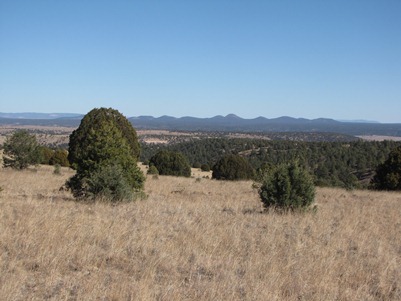
This pack is special because both breeding adults have only three legs. Alpha male AM871 lost his leg when he was caught in a leg-hold trap. Alpha female AF861 suffered a gunshot wound to her leg that required amputation. In spite of their lost legs, the pair has produced several litters of pups. This year they had seven! Biologists with the Mexican wolf reintroduction project are keeping a close eye on the pack to see how many of the pups survive until the end-of-year population survey in January 2012.
The Middle Fork home range consists of rolling grasslands, rugged canyons, and forests of ponderosa pine, piñon, juniper, and oak trees.
We pitched our tent in a valley surrounded by low hills. Night comes early in late November. Cold air sinks down into the valleys as soon as it gets dark. We were glad to crawl into our warm sleeping bags right after supper and listen to the sounds of evening in the woods. A gentle breeze made a rustling sound in the pine needles. Raven wings beat a soft “chuff, chuff” as the big, black birds flew low overhead and settled into nearby treetops for the night.

As the evening sky faded to the dark of night, we heard musical notes in a minor key drifting down a small ravine from the hills to the east. We sat up in order to better hear the lobos howling. There was at least one low voice and some higher notes that may have been half-grown pups. The song moved up and down the scale for twenty minutes, sometimes stopping for a minute or two and then starting again. Now and then we thought we heard answering voices from much farther away.
The following morning the Middle Fork lobos howled again as it began to get light. Again, they sang for over twenty minutes, with answering howls from the southeast. As the sun rose, it was a chilly +14°F in the valley. Wisps of smoke from our campfire of the night before hung in the air.
The sun shone through the last colorful leaves of autumn. Can you identify the kind of leaves shown in this photo? Is the tree a pine, juniper, or oak? (Answer at the end of the story.)

Later in the day we took a hike on a ridge east of our camp, in the general direction from which we heard howling. The ground was rocky and covered with fallen tree trunks left from an old forest fire. We found no lobo sign, but enjoyed the warm, fall sunshine.
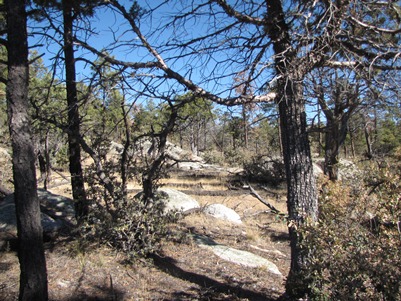
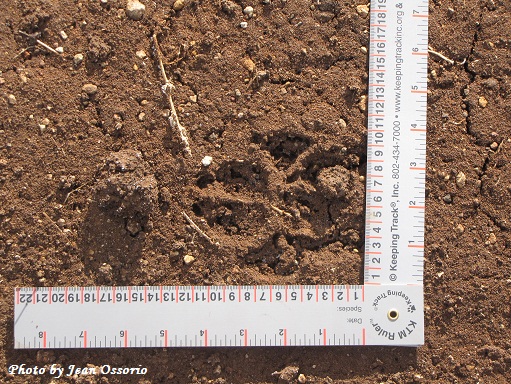
The next morning, before daylight, we heard wolves briefly howling twice, at about six and seven in the morning. As we drove along the forest road on our way to the highway, we found fresh wolf scat on the road in the direction from which some of the howls seemed to come. The scat was so fresh that it was still very damp and there were drops of liquid on the ground underneath. It was also full of elk hair, giving us a clue about what the wolf had been eating. (Note: the track ruler measures in centimeters, not inches. Three centimeters equals a little less than 1 ¼ inches.)

A week later we returned to camp near where we found the fresh wolf scat. In just a few short days the warm, sunny afternoons of late autumn had turned to blustery, snowy days of early winter.

During the night we heard wolf music to the northwest, not far from where we heard the Middle Fork pack in November. After breakfast and some good, hot coffee, we set off to hike down the snow covered road in the hope of finding lobo tracks.

The snow began to fall harder as we walked, covering the rocks and fallen logs with a blanket of white.

Cooney Point was barely visible through a veil of snow and fog.


By noon the snow was falling heavily and the temperature was dropping. We decided to cut our trip short. We were afraid we might get snowed in, because the road crews don’t plow the roads into the heart of the Gila National Forest. We found no tracks, but we did enjoy the early morning concert by the Middle Fork lobos. We plan to return to their home range early in 2012. We’ll report on what we find.
Answers to questions:
The track of a large, omnivorous animal is a black bear track.
The track of an ungulate that is the lobo’s favorite food is an elk track.
The leaves in the close-up photo of the tree branch are leaves of an oak tree. The acorns of this Gambel oak provide food for wildlife. Native Americans use them in traditional dishes like acorn stew. Deer also browse on the leaves.
Follow the Pack Update, August 22, 2011
A long weekend in Mexican wolf country
Follow the Pack recently spent a long weekend in the Mexican gray wolf recovery area. Late summer in eastern Arizona and southwestern New Mexico is the monsoon season. The weather is pleasantly cool, with rain showers almost every afternoon.
We camped on Saturday night in the home range of the Paradise Pack in Arizona. The pack consists of the nine-year-old alpha male, AM795, his six-year-old mate, AF1056, and five pups born earlier this year. We saw lots of cows…
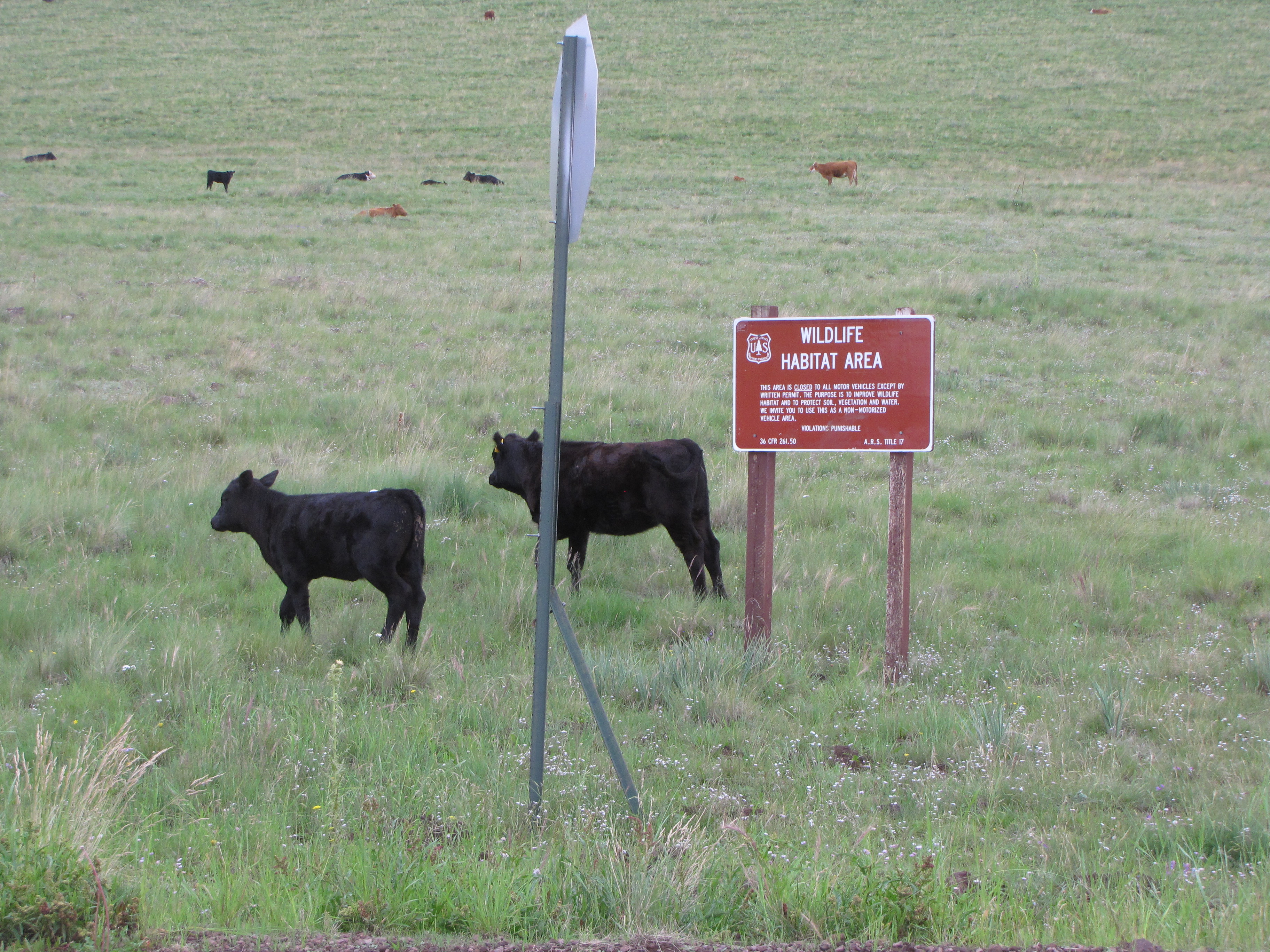
…and wildflowers…
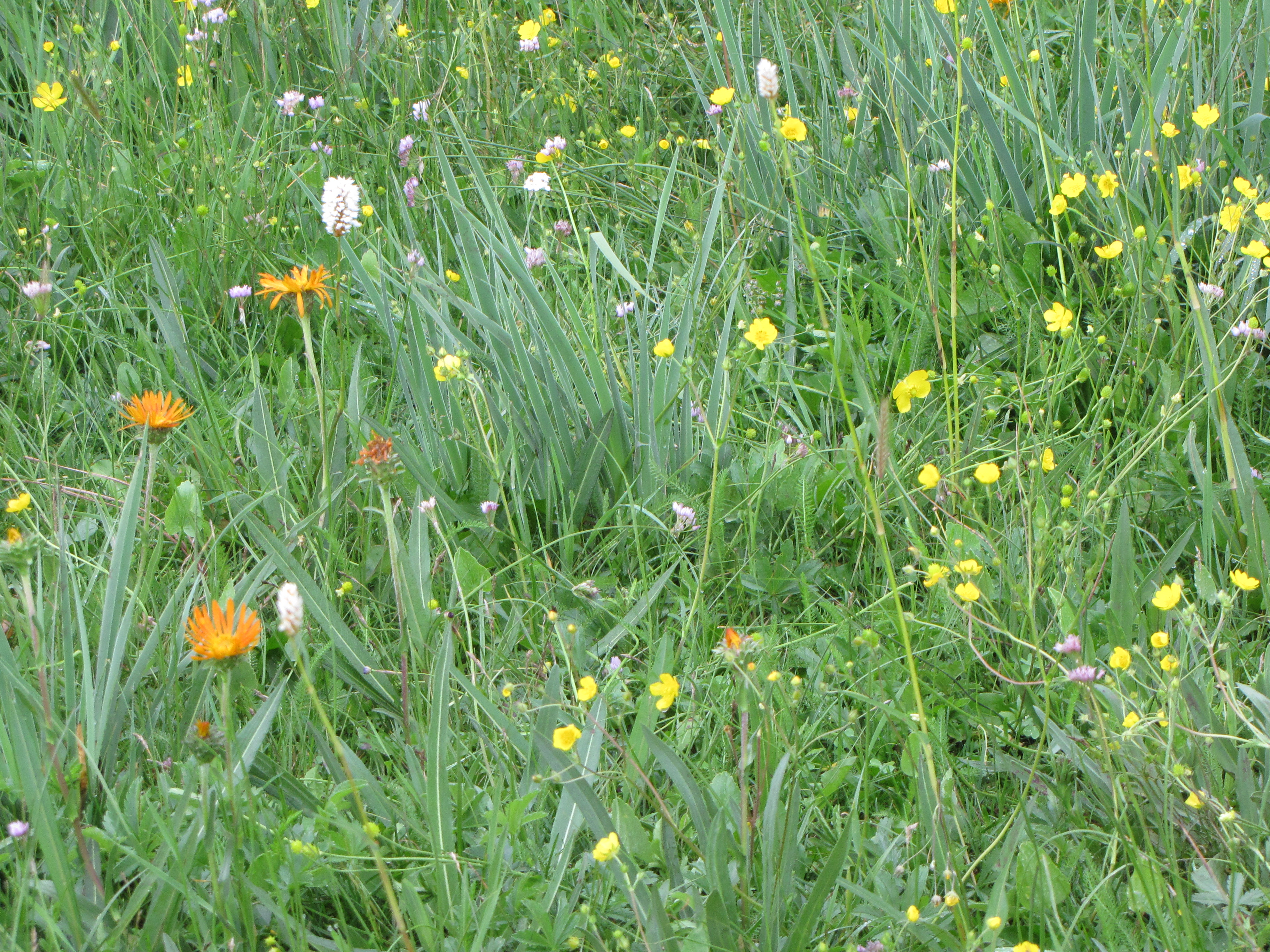
…and colorful mushrooms…,
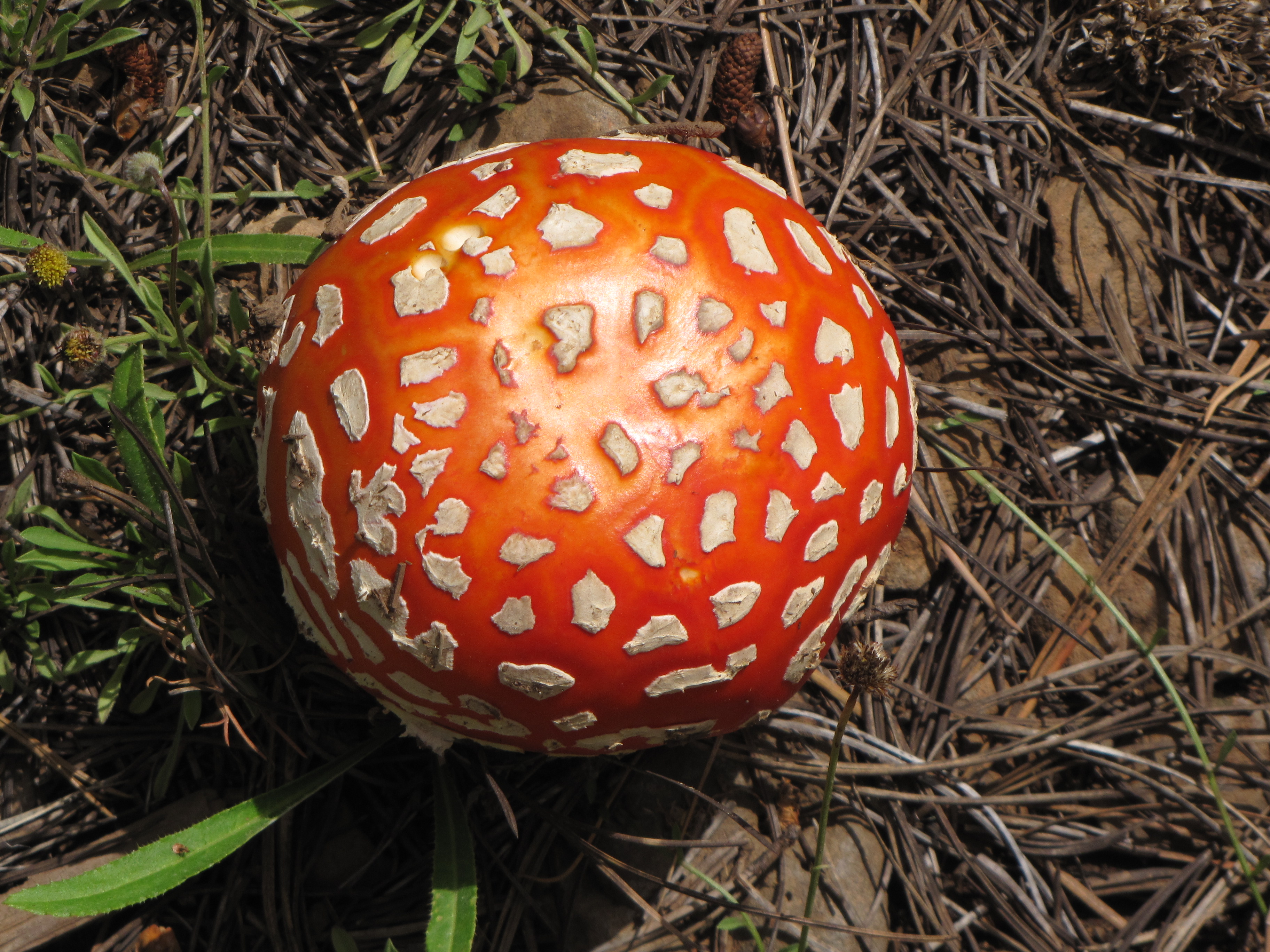
…but not a single wolf or wolf track.
After a very damp night and a short hike on Sunday morning, we decided to move to New Mexico and look for signs of the San Mateo Pack. The alpha female of the San Mateo Pack, AF903, was born in the wild, most likely in 2003. She is now eight years old. Her mate, AM1157, was also born in the wild. He had his third birthday in April. Like the Paradise Pack, the San Mateo pair had at least five pups this spring.
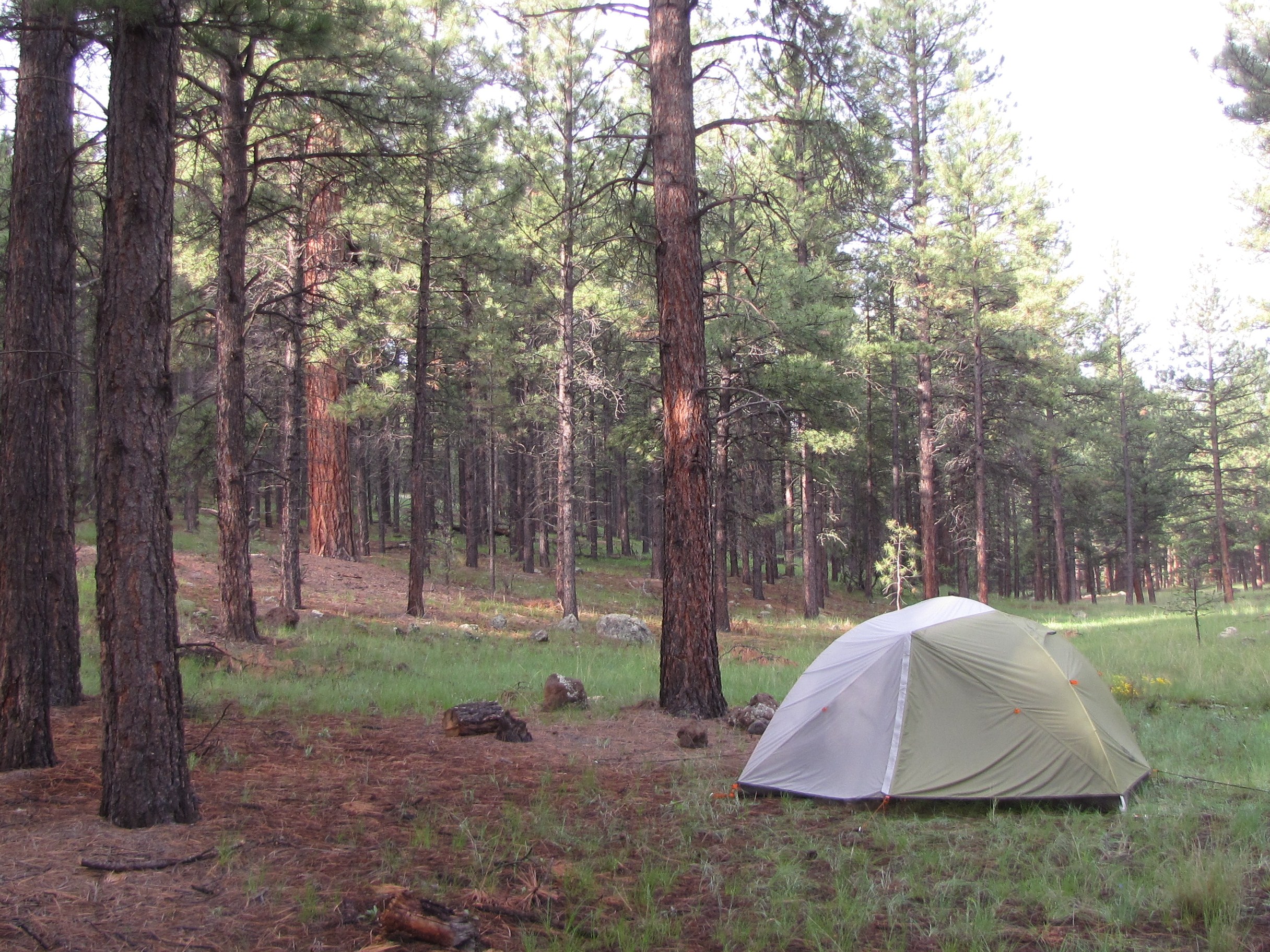
We pitched our tent in a little valley among some ponderosa pine covered hills. Monsoon rains had resulted in a good growth of green grass. Elk, like two males with large racks of antlers that we saw as we drove to our campsite, had the grass all to themselves. As far as we could tell, there were no cows in the area to compete with the elk for the succulent grasses.
We crawled into our tent early to escape the rain. Sometime after midnight we awoke to the sound of hoof beats on the rocky hillside nearby. Could they be the footsteps of deer? Elk? It was too dark to see what sort of animals passed so close to us in the night. We solved the mystery the next morning, as we set off on a hike up the canyon. Just a short distance from our camp, we found fresh tracks of an adult elk and an elk calf crossing the muddy forest road.
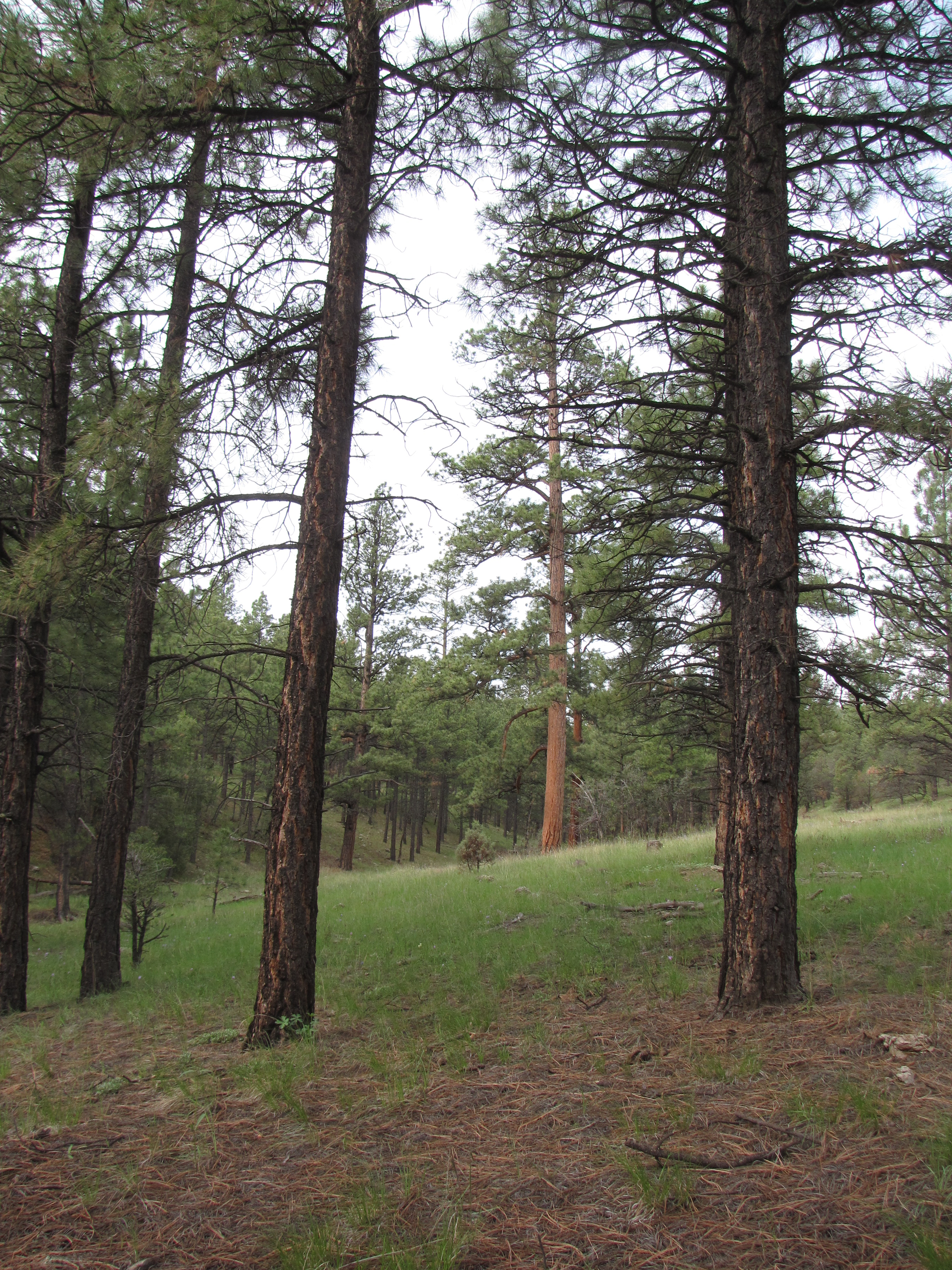
As we continued on our hike we saw more good elk and wolf habitat…
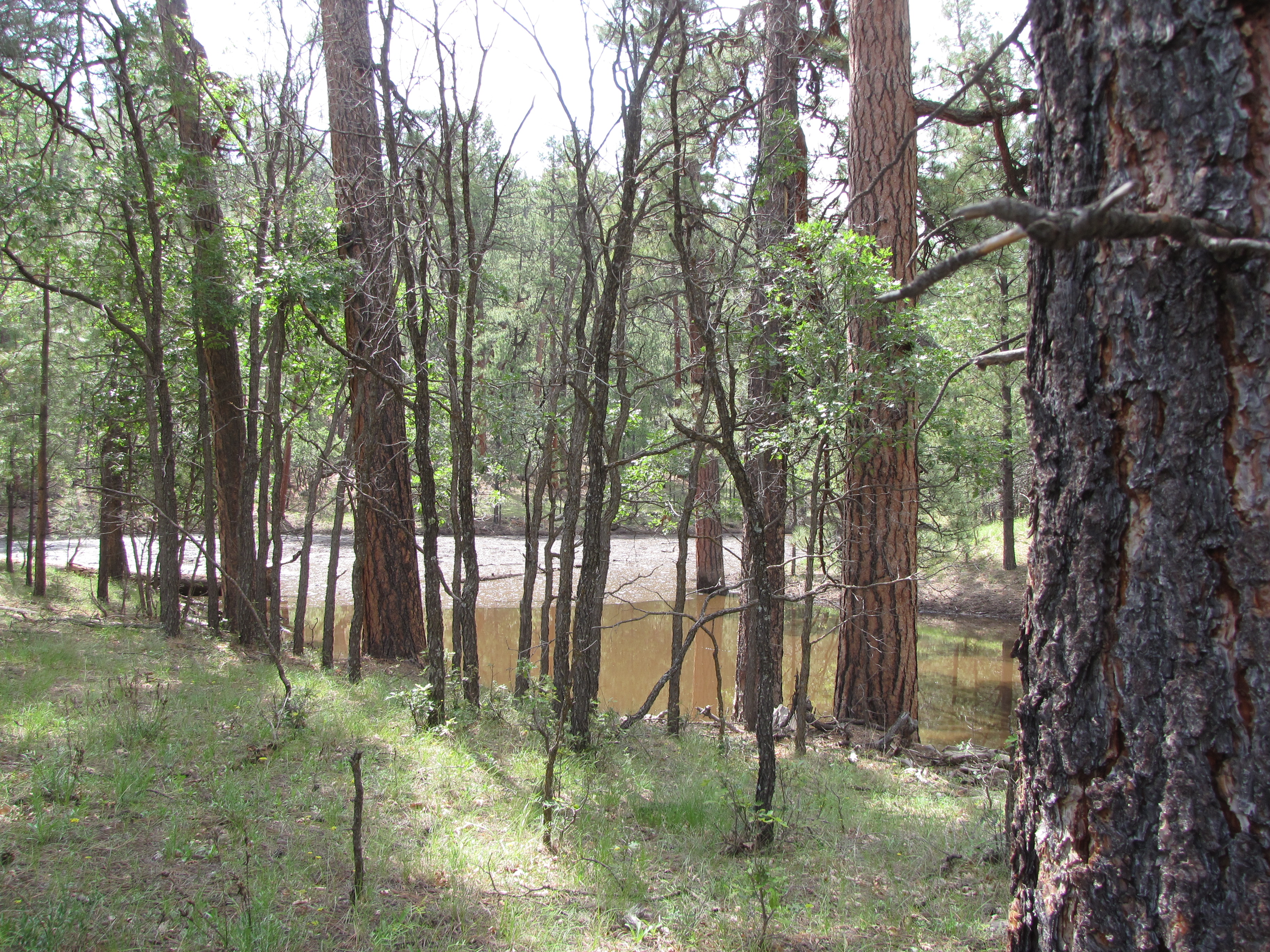
…and a stock tank (known as a pond in many parts of the United States) filled to the brim with muddy water from the recent downpours…
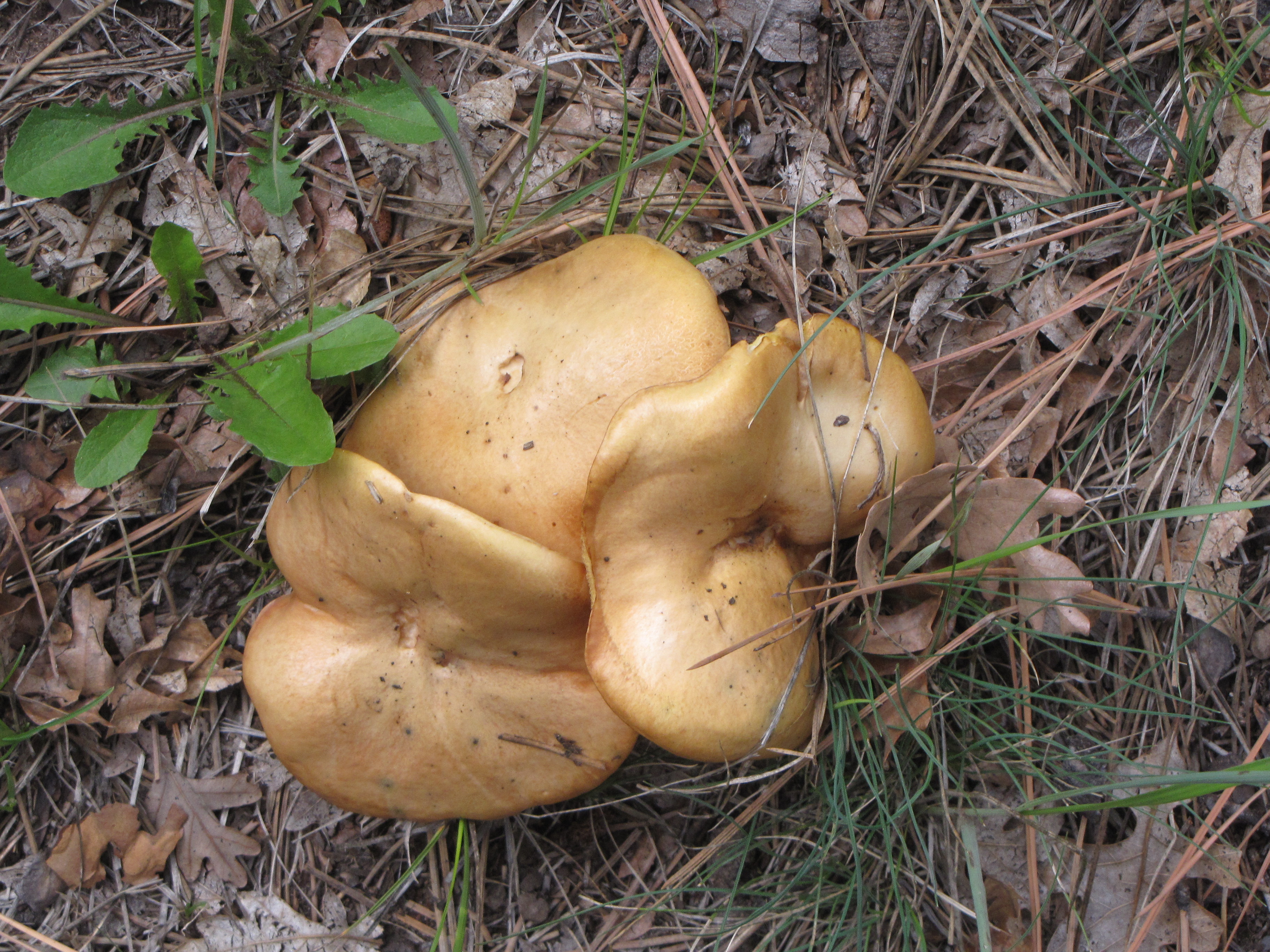
…and more colorful mushrooms.
The most exciting thing we found, by far, was a long line of wolf tracks running straight down the road for at least a quarter of a mile.
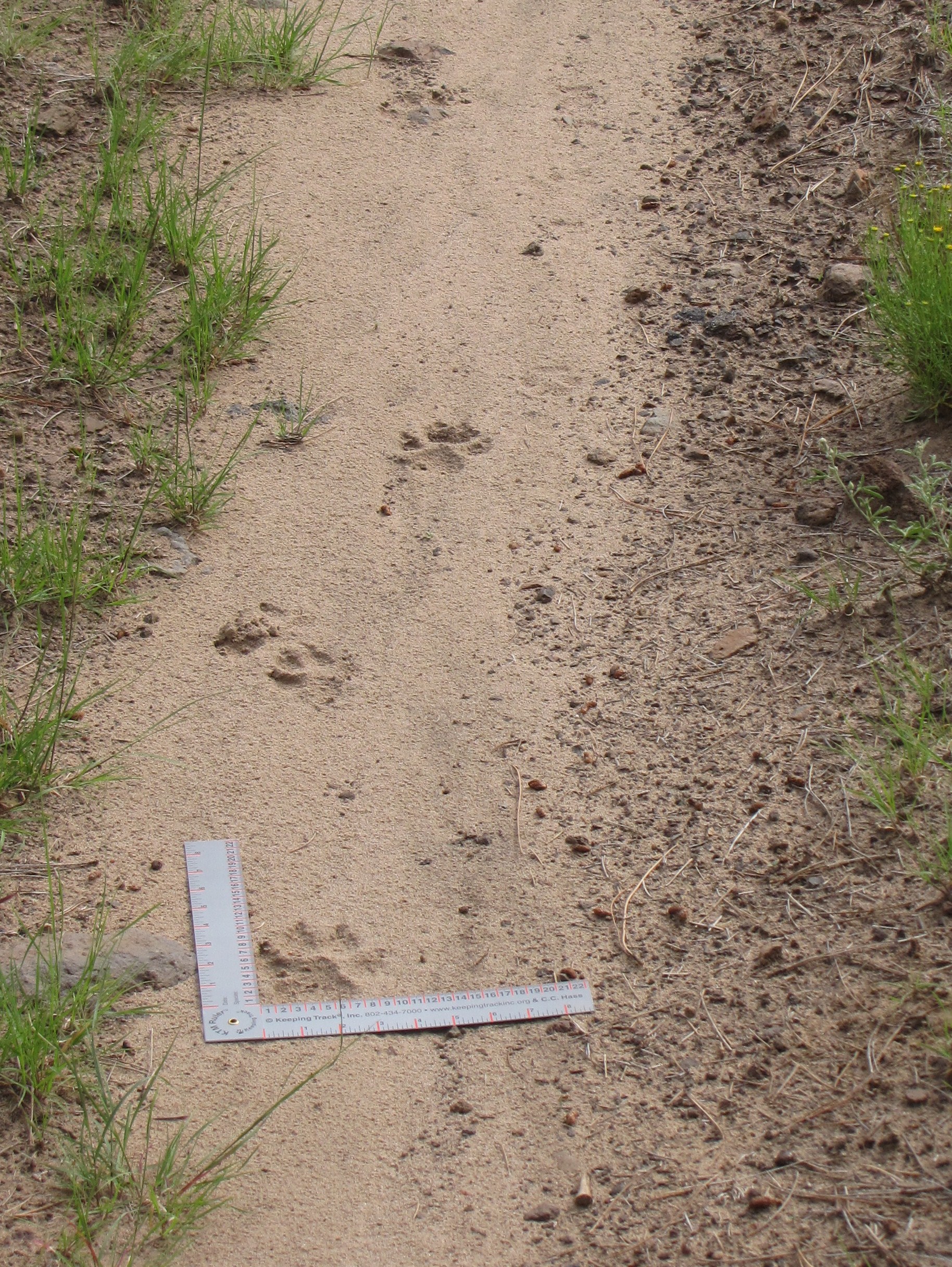
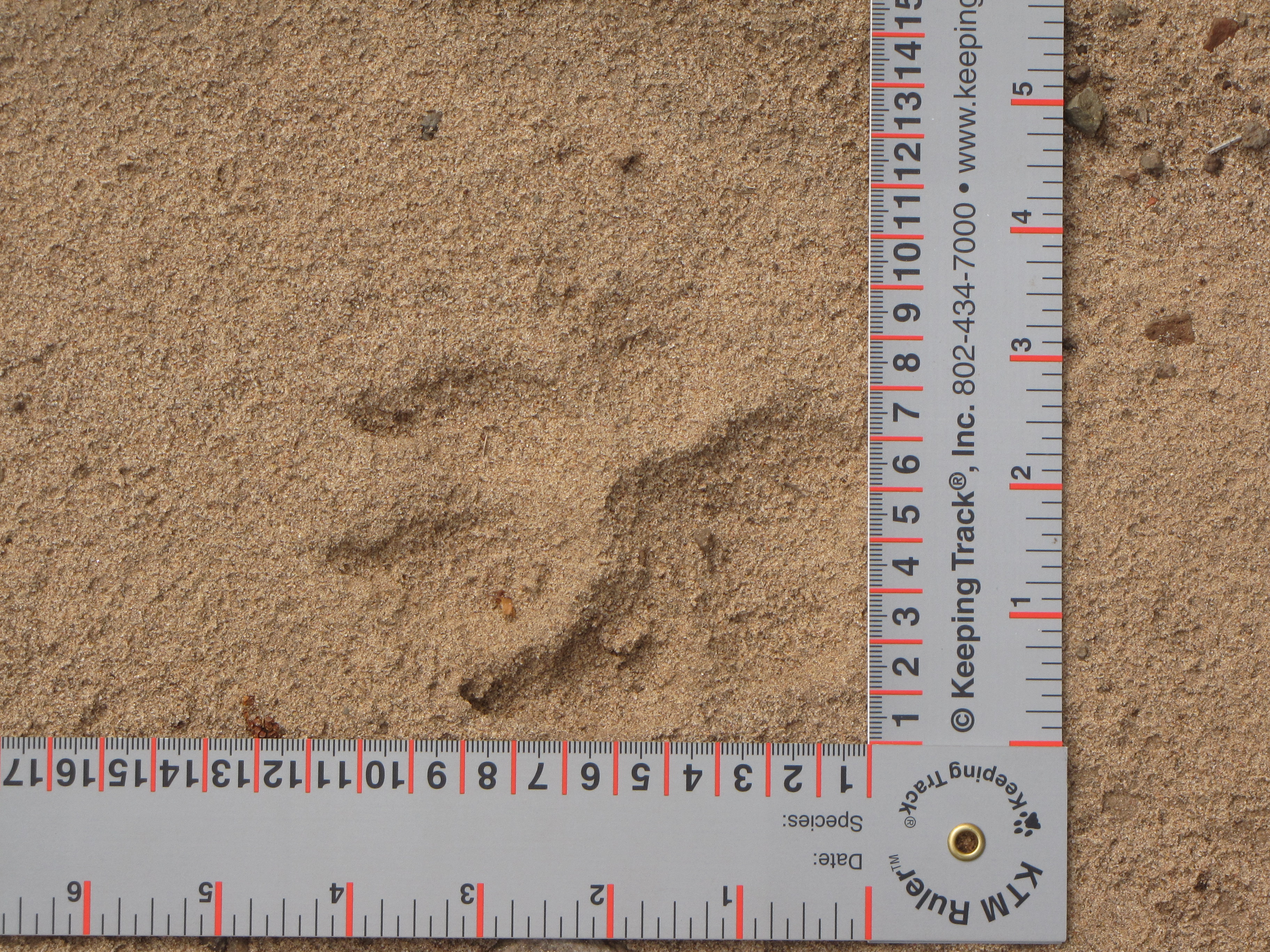
The cloudy skies made it hard to take good photographs of tracks, but you can see that this wolf track is about 10.5 cm (over 4 inches) long and about 9 cm (about 3½ inches) wide. We were so excited to find tracks of at least one San Mateo wolf that we didn’t mind being soaked by a sudden, heavy shower on the hike back to camp.
Follow the Pack hopes to return to San Mateo territory in September or October, when the weather is not so wet and there’s a little chill in the air. When we do, we’ll report on what we find.
Follow the Pack Update, June 15, 2011
Exciting wildlife adventure on the Fort Apache Indian Reservation

Follow the Pack spent an exciting five nights and four days on the Fort Apache Indian Reservation, looking for Mexican gray wolves and other wildlife and learning about the history and culture of the White Mountain Apache Tribe. The tribe has welcomed Mexican wolves to tribal lands since 2000. A number of lobos make their home there today.
As we drove from New Mexico to the 1,600,000 acre reservation in eastern Arizona, we encountered smoke from the huge Wallow Fire burning in the Apache National Forest. The thick smoke burned our eyes and made day seem like late evening. When we reached the reservation late Sunday afternoon, we found we had left the smoke behind us. The air was clear and the sky was deep blue.

Our tour began on Monday with a trip to historic Fort Apache, which housed soldiers during the Apache Wars of the late 19th Century. The oldest building at the fort is this log cabin dating from 1871, known as General Crook’s Cabin. Walking around Fort Apache, you can imagine what life must have been like for men stationed at a frontier fort without electricity, air conditioning, central heating, and other modern conveniences.

We continued our tour at the Kinishba Ruins. This village began as a group of pit houses in about AD800. By AD1325 as many as 400-800 people lived in the village, which by then consisted of about 600 ground-floor rooms. The people who lived in the village are believed to have been the ancestors of today’s Hopi and Zuni people.

In the evening, we enjoyed a picnic of traditional Apache dishes, including acorn stew and fry bread. After dinner, the father and sons of White Mountain Apache tribal wolf biologist, Krista Beazley, sang and played drums.

Ms. Beazley (in the pink shirt) and her daughter danced to the music, with trip participants joining in.
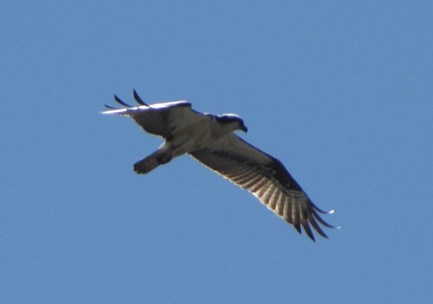
Tuesday morning we got up early to go looking for wildlife. At Hawley Lake we watched two ospreys soaring above the lake. Now and then one of the birds would plunge down to the lake after a fish.

We stopped at a place where photographs of wolves have been caught on remote cameras, called “camera traps.” We placed a camera trap on a tree to see if we could catch a photo of a wolf or other animal.

Then Krista Beazley demonstrated how radio-telemetry works. Using a radio receiver with an H-shaped antenna, you can hear the signals coming from a wolf’s radio collar, helping to locate the wolf.

Back at camp, we learned how to make Apache fry bread, no measuring cups or spoons allowed! Hands are for kneading the dough. After the balls of dough rise, you flatten them between your hands and slip the flattened dough into hot oil. The dough puffs up and turns to hot, delicious, brown, fry bread.

Later, we watched the amazing Apache Crown Dancers, who came all the way from the village of Cibecue to dance for us.

Wednesday morning we again set off early to look for wildlife and check the camera trap for photos of any animals that happened to walk by and set it off. As we drove into the forest, we got a surprise. A big, black bear ran across the road in front of our van, his dark coat shiny in the sunlight. Later, we saw two more bears, but they were much farther away and partly hidden in the woods. Not long after we saw the first bear, we found bear tracks along the road. Black bears have big paws!
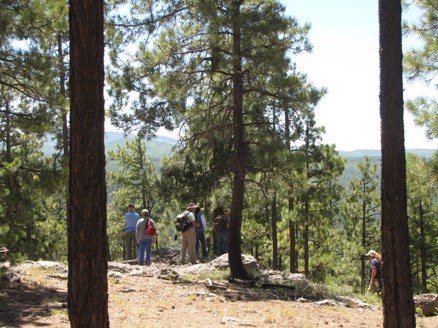
On our way to check the camera trap for photos, we hiked down a road and through the forest. We found a line of wolf tracks, but the sun was too high in the sky to get good photos of the tracks. Before going on to check the camera trap, we hiked to an old den of the Paradise Pack. The den site was among rocks on a steep canyon wall with an amazing view.
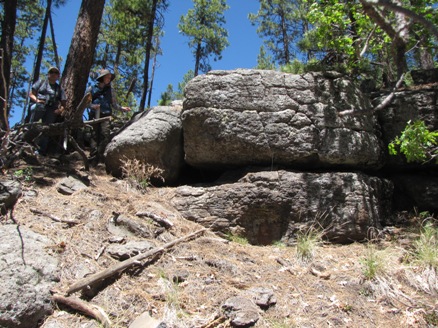
We could imagine a litter of pups emerging from the den for the first time, their eyes dazzled by the sun, sniffing the fresh air and tumbling playfully in the pine needles.
After visiting the old den site, we went to check on the camera trap.
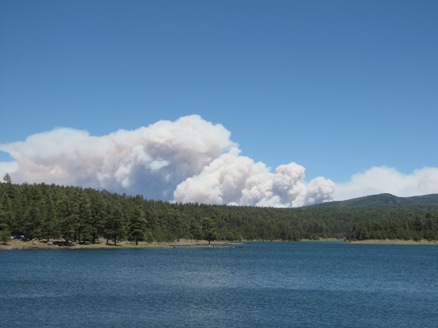
Unfortunately, the only photo we found when we downloaded the pictures from the camera was a photo of us, walking away from the tree where we fastened the camera the day before. As we drove back to our base camp, we stopped at Hawley Lake to watch the smoke from the Wallow Fire billow up into the sky. We were concerned about all the people and wild creatures whose homes were threatened by the enormous fire.

Thursday morning we took a three-and-a-half mile horseback ride through the beautiful ponderosa pine forest, stopping to rest at a grassy meadow halfway through the ride. We were glad to take a break. We imagine the horses were, too!
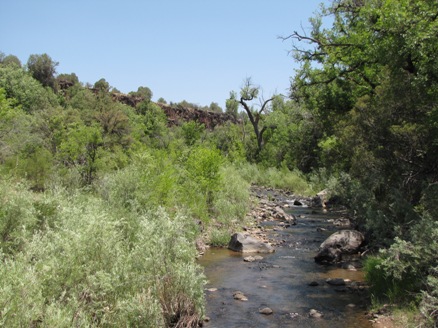
Although we didn’t see any Mexican gray wolves, we enjoyed seeing the beautiful mountains, meadows, lakes, and streams on the White Mountain Apache tribal lands.

We were thrilled to see wildlife, from the big, black bears to this tiny butterfly.
Most of all, we appreciated the friendly welcome we received from our White Mountain Apache hosts. They made us feel right at home. We would happily sign up for another trip tomorrow.
Follow the Pack Update, January 20, 2011
Winter snow makes spotting and tracking wildlife easier
Follow the Pack made two trips to the Mexican wolf recovery area this winter, one in mid-December and one in early January. Snow made finding tracks much easier than it was during the summer and fall.
On a visit to the home range of the Hawk’s Nest pack in Arizona shortly before Christmas, we found the tracks of several wolves along snowy forest roads. One line of tracks led to a reflective road marker, where the wolf left a scent mark of urine. After leaving its mark, the wolf returned to the road, where walking is easier. We often observe this behavior when there is snow on the ground.
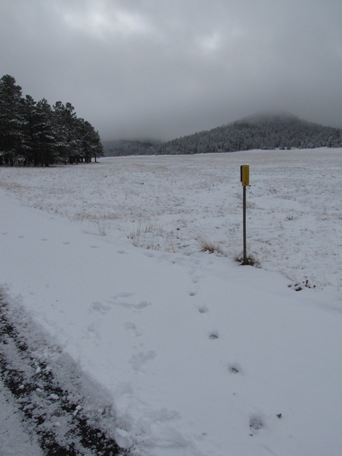
Mexican wolf tracks lead to a road marker, where the wolf left its scent mark.

Mexican wolf tracks on a forest road in Hawk’s Nest home range.
In early January, we returned to the home range of the Middle Fork pack in New Mexico. We found no wolf tracks, but the footprints of elk, coyotes, wild turkey, rabbits, mice, and ravens were everywhere. Coyotes howled every morning and evening.

Coyote tracks in Middle Fork home range; East Elk Mountain and O Bar O Mountain in background.
We found many more tracks on a return visit to Hawk’s Nest territory. This time we saw some of the animals that made them, including these elk. Elk are the main prey animal for Mexican gray wolves.

Elk grazing and resting at dusk.
Although we saw and heard no lobos, we enjoyed hearing coyotes howl and observing elk and pronghorn in the snowy grasslands. It was fun to try to figure out who made the many trails of tracks we found in the snow. Most of all, we enjoyed camping and hiking in the peace of winter, when it is so still that the wing beats of ravens can be heard, as the big, black birds fly overhead. We’ll definitely be making another winter trip in 2011!

Watching for pronghorn from our campsite in Hawk’s Nest territory. Escudilla Mountain in the background.
Photo of wolf tracks with ruler by Billie Hughes. All other photos by Jean Ossorio.
Follow the Pack Update, November 24, 2010
Few wildlife sightings, beautiful sunsets mark late fall trip to wolf territory

Follow the Pack spent five nights camping in the home ranges of the Hawk’s Nest and Rim packs of Mexican gray wolves in mid-November. We saw very little wildlife other than coyotes, wild turkeys, a pair of bald eagles, and some waterfowl, and found only a single dried-up wolf scat and no fresh wolf tracks. We did enjoy beautiful sunsets almost every night, however.

The weather is turning cold in the wolf recovery area. The temperature dropped below freezing every night. Little snow fell, but heavy frost made the tall grass sparkle in the morning sun.

During the day, we hiked the dusty, forest roads looking for tracks and scat. Just after this photo was taken, we surprised a coyote crossing the road in front of us. As soon as he saw us, he dashed away into the woods.
As the day drew to a close, we sat around the fire, listening for the howls of wolves and the sounds of other animals.

As night fell, we watched the stars of the winter sky make their appearance, including the Pleiades, or Seven Sisters; the Hyades, a little group of stars that looks like a v-shaped flock of geese flying south; Orion, the mighty hunter; and Sirius, the brightest star in the night sky, which some cultures identify as the Wolf Star. Next time we watch the brilliant Wolf Star from the recovery area, we hope we’ll hear the music of Mexican wolves from the dark hills nearby.
Follow the Pack, October 22, 2010
Pups growing fast; Hawk’s Nest pack moves around
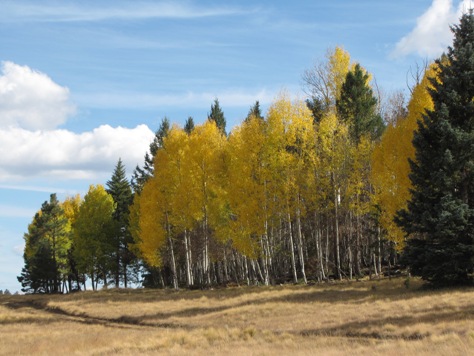
Follow the Pack just returned from five days camping and tracking Mexican gray wolves in the home range of the Hawk’s Nest pack. We saw signs of fall everywhere in the mountains of eastern Arizona. The leaves of aspen trees have turned from soft green to brilliant gold.
Small animals like this spruce squirrel are busy preparing for the long, snowy winter ahead.

Mexican gray wolf pups have been growing all summer and are now able to travel with their packs. The weights of three Hawk’s Nest packs pups caught and radio collared since August ranged from 20 to 35 pounds. Soon the pups will be difficult to distinguish from adult wolves when seen from the air.
The Hawk’s Nest wolves are moving around much more than they did while the pups were small, making them more difficult to locate and see. On this trip we didn’t see or hear the wolves, but we did find some of their tracks.
Billie made casts of several tracks by pouring track-casting material into the them. After the casting material hardened, she was able to remove the casts from the dusty surface of the road and clean them off. The resulting casts make wonderful souvenirs of a trip to the home range of the Hawk’s Nest pack.
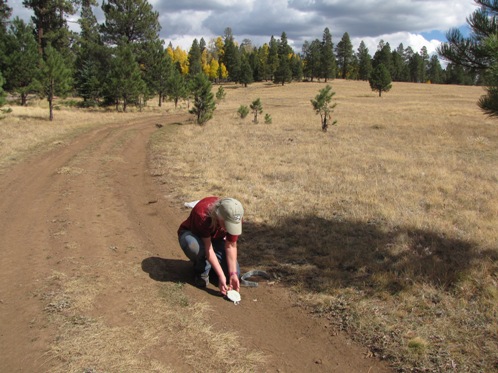
Lifting track cast from the dust.
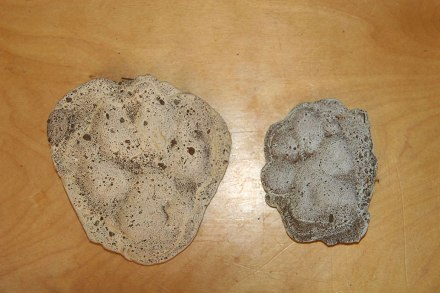
Casts of adult Hawk’s Nest wolf and pup.
Follow the Pack, May 26, 2010
Return to Hawk’s Nest territory
Follow the Pack and friend Billie hiked about four miles in the home range of the Hawk’s Nest pack in eastern Arizona on Monday. The weather was sunny, with a high temperature in the 60’s.
We found several wolf scats along the way. As we hiked back to camp, we stopped to make a cast of a wolf track in the dried mud of a forest road. It takes a half hour or more for the cast to get hard enough to remove from the ground, so we sat down to wait and have a snack.
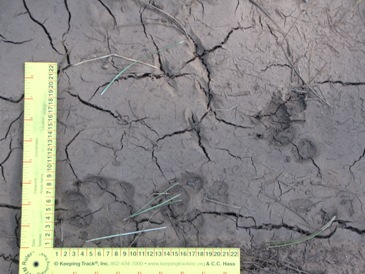
Mexican wolf tracks in dried mud
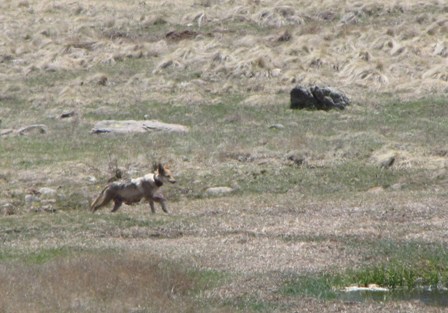
While we waited, we had a good view of a grassy valley. It must have been our lucky day, because we soon noticed three canids (members of the wild dog family) moving up the valley. Although they were as far away as the length of one-and-a-half football fields, a look through the viewfinder of my camera clearly showed the dark radio collar on one of the animals. They were Mexican gray wolves!
All three wolves moved slowly up the valley. Apparently they didn’t realize we were watching. Perhaps the breeze was blowing our direction, so they couldn’t catch our scent. The wolves didn’t hurry, as long as they didn’t know we were watching.
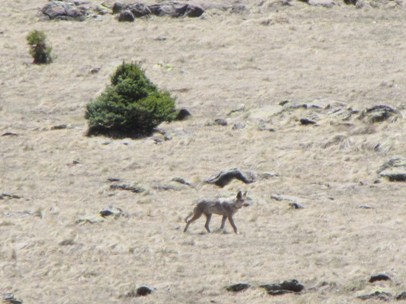
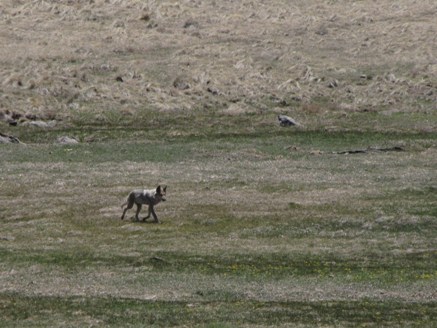
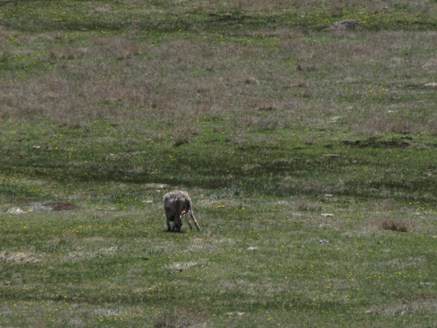
One lobo even stopped to check out something on the ground.
Finally, one of the wolves must have gotten a whiff of us or heard us talking, even though they were still far away. The wolves gave two or three short, sharp barks. One gave a single howl. All three wolves ran quickly up the ridge across the valley and disappeared.
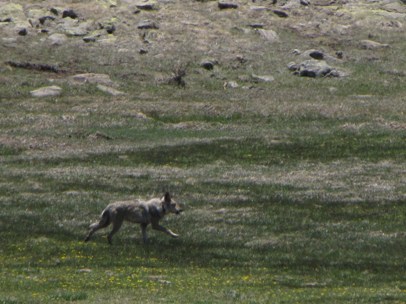
When they caught our scent, the wolves quickly ran up the hill and out of sight.
I’ve been following the Mexican wolf packs for twelve years, but this was the first chance I’ve had to get good photographs of lobos in the wild.